
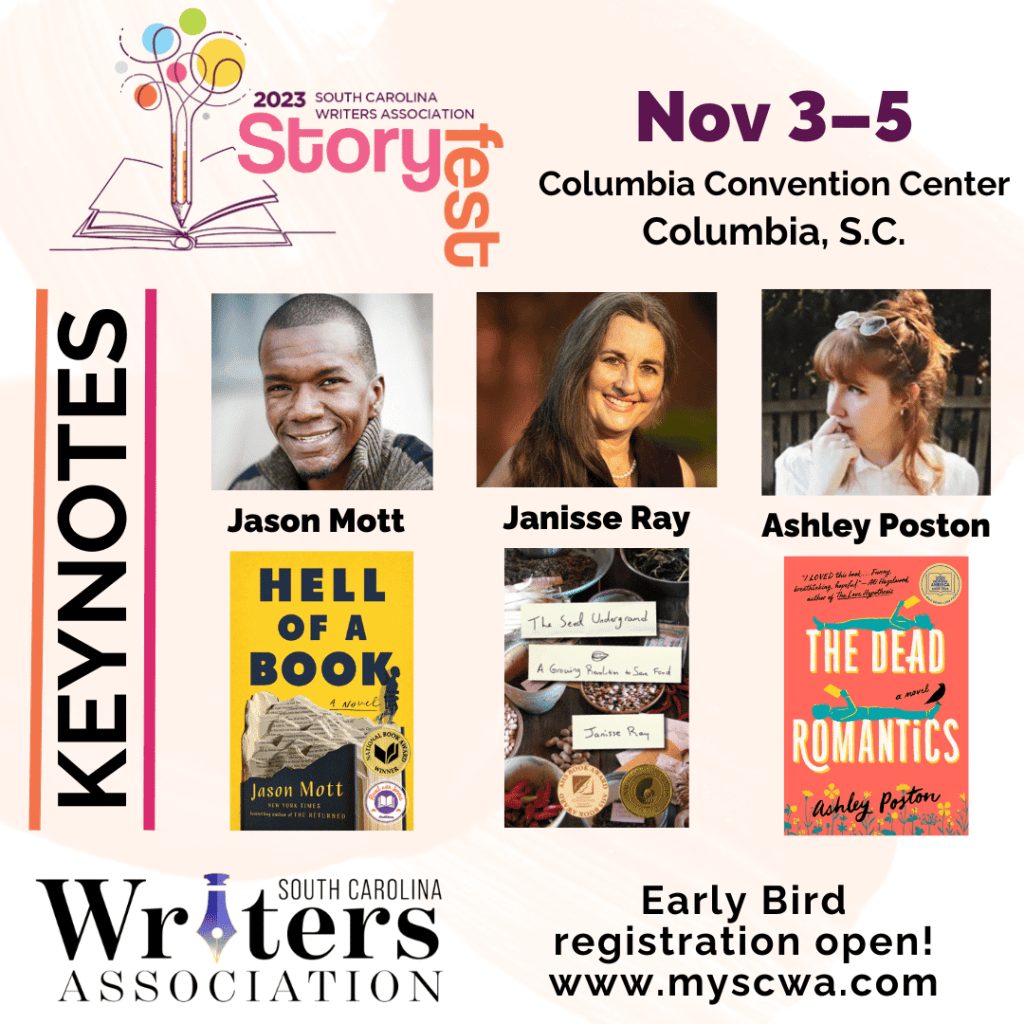
On June 24, 2023, Kasie was joined by Paul Davis and Ash Smith, SCWA board members and organizers of the upcoming Storyfest event in Columbia. Here are the show notes:
Theme for the day
The Wonderful World of Writing Conferences
Agenda
- Guest co-host Paul Davis
- Guest co-host Ash Smith
- What is a Writing Conference and how do they work?
- What to look for in a Conference
Segment 1
Rex is on vacation for the next three shows and man have I lined up some potential job threats!
This week I’m joined by Paul Davis, prize-winning journalist and Brown University grad. As a freelance writer and reporter, he has written for large and small newspapers from the Tampa Tribune to The New York Times. At the Providence Journal, he chaired the newspaper’s in-house writing committee. He won awards for his stories about the homeless, New England’s struggling fishermen, the Narragansett Indians and the working poor. The Journal submitted his seven-part series on the Rhode Island-South Carolina-West Africa slave trade for a Pulitzer Prize. Paul’s also our SCWA Vice President and chair of the Events & Education committee which is responsible for the upcoming Fall 2023 Storyfest event (more on that later).
and
Ash Smith, another SCWA Board member with a BFA in creative and professional writing. Ash is currently are working on their first novel. We met at the Fall 2022 Pawley’s Island Conference for SCWA and were fast friends. Ash has served with the Membership Committee in the capacity of outreach at events including Charleston’s AtomaCON in April and Columbia Writers’ Alliance’s Literary Arts Festival in May. As with most volunteer positions, once is never enough and everytime I’ve asked Ash to serve, they’ve stepped forward with enthusiasm. So thanks, both of you for being here.
We’re going to talk a LOT about Storyfest and what it is and how people can learn more and get registered. The Early Bird pricing expires next week, so now’s the time!
Segment 2
What is a literary conference? Why do we do them? What advantages do they offer?
When was the first one you went to? What did you get out of it?
I think the consensus is YES, writers should go to conferences, but I googled it anyway just to see. Here’s a link to a Writers Digest article with these three reasons to go (it might be a 2016 post by Tomi Adeyemi, the crazy-bestselling author of Children of Blood and Bone well before she broke out into mega-stardom):
- Learn – conferences have writers from every level and every genre PLUS publishers, agents, instructors, editors, and they’re all there to share what they know with YOU.
- Networking – every successful writer can trace their “break” or their success back to an encounter at a writers conference – someone they met who opened a door previously closed.
- Pitch – agents, editors, publishers, readers – they’re all onsite and you can (and should) pitch to them. Tell them what you’re working on. Practice explaining your work. Even slushfest, as painful as it is, has something to offer in the Pitch category.
What are the expectations of a Conference?
What have you seen that worked really well?
What have you seen that failed spectacularly?
Segment 3
This New York Book Editors blog talks about benefits of conferences like:
- Get serious about writing – there’s a cost to attend a conference (admission, travel, expenses) and that’s investing in your future as a writer. It’s saying, “I believe enough in myself that I’m willing to pay $XX to attend this event and improve my chances.”
- Learn from other writers – the best teachers are them that’s walked the path.
- Learn from editors – they have visibility to A LOT of work; editors are valuable resources for advice, do’s and don’ts and can help you prioritize your work in the early stages
- Learn from literary agents – also have visibility to a LOT of work and some specific (sales) perspectives on manuscripts
- Pitch to agents – while sometimes having an extra cost, pitching to agents at a conference can sometimes be a better on-ramp. You’re face-to-face, not a faceless email it’s easy to reject.
- Break up the monotony – if you’ve been in a write-revise-submit-rejected death spiral, a conference can provide new avenues, new perspectives, and new energy to your writing experience.
- Tax write-off – writing is a business and if you spend money on it, guess what? That money is tax deductible; anything you spend in pursuit of this new career is eligible as a deduction.
This Writing Tips Oasis blog offers these five reasons attending a conference is the right thing to do:
- Make genuine connections – so this goes to the SCWA’s mission of “association” which is to help writers find other writers with whom they’d like to share some additional expertise, experiences, or opportunities. It’s how Ash and I met 🙂
- Honing your craft – the craft workshops are all about helping you improve. Last Fall Ash and I attended Leigh Stein’s session on novel beats and it really helped me take apart the vampire novel. Whether it ever gets reassembled is less certain, but nonetheless…
- Gain knowledge about your genre – so genre have expectations and if you’ve been reading in yours you might know them, but if you’re writing in them, you MUST know them. You’ll also learn about the marketability of your genre, too.
- Meet authors you admire – it’s great when a well-loved author is on the faculty for the conference you’re attending. I was glad to learn more about the world Therese Anne Fowler lives in, I’d read Z: A Novel of Zelda Fitzgerald before I met her at Pawley’s Island.
- Step out of your daily life – and I’d add, out of your comfort zone; writers can be habitual creatures and creating can be a lonely process, disrupting those two things now and then can invigorate your writing life.
Segment 4
So this is usually our “how to” and I’d like to spend it reiterating how to sign up for Storyfest but also how to strategize your conference attendance. Maybe we work this list:
- Decide what your conference budget will be early in the year
- Start researching conferences and determining which ones you’ll attend
- Make a list of the things you hope to get out of the conference
- Make a list of the things you can BRING to the conference – what will you add to the experience for others to takeaway?
- Decide what you will use to evaluate your return on investment – what metrics will you use to decide if this conference was a good one?
- Write down things you hope will NOT happen. This can help you anticipate the bullshit that’s likely to come up and then you’ll have a strategy for dealing with it when it happens.
 #WriteOnSC Radio Show and Craft School